
Luminous Labs Essential and Kini
Our experiences incl. 5% discount code
-
 Oliver Fröhner
- Aktualisiert am 30. April 2026


Photobiomodulation (PBM) - Red Light Therapy: Scientifically Based Health Promotion
Photobiomodulation (PBM), also known as red light therapy, is a non-invasive method that uses light in the red (620–700 nm) and near-infrared spectrum (700–1440 nm) to stimulate cellular processes. Discovered in 1967 by Endre Mester, who observed accelerated wound healing and hair growth through laser light in experiments with rats, PBM has established itself as a versatile form of therapy in areas such as dermatology, neurology, sports medicine and general health promotion. By using low energy densities (1–100 J/cm²), thermal damage is avoided while cellular functions are supported.
PBM works primarily by stimulating the mitochondrial respiratory chain, in particular the enzyme cytochrome c oxidase, which increases the production of adenosine triphosphate (ATP) and modulates reactive oxygen species (ROS). These processes promote cell regeneration, reduce inflammation and support general health.
The following introduces the scientifically proven benefits of PBM and the innovative devices from Luminous Labs (Essential and Kini), which make this technology accessible for home use.
PBM for home use with Luminous Labs
Essential and Kini
Essential
Holistic and powerful
The Essential is a full-body panel for comprehensive red light therapy at home. With red (660 nm) and near-infrared (850 nm) wavelengths, it supports cell health, sleep optimization, stress reduction and regeneration.
The Brain-Pulse function (10 Hz) promotes mental clarity. Ideal for longer sessions (10–20 minutes, 2–3 times a week) and comprehensive applications.
Kini
Compact and mobile
The Kini is a portable, lightweight (0.03 kg) red light therapy device for targeted applications on the go. With 20 LEDs (660 nm red, 850 nm near-infrared) and 80 mW/cm² intensity, it is ideal for skin care, muscle regeneration and cognitive support (10-Hz brain pulse).
Thanks to skin-friendly Kini stickers, it can be attached hands-free to areas such as the back, neck or face. Perfect for active people who value flexibility.
Luminous Labs 5% Discount Code [Advertisement]
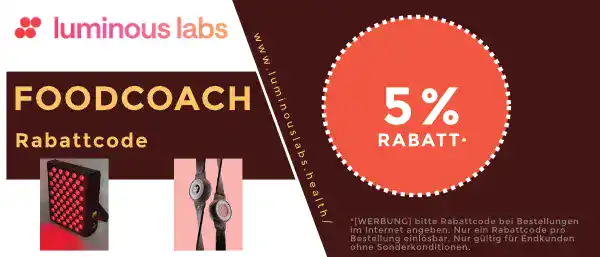
With our discount code “FOODCOACH” you get a 5% discount on the Essential and Kini products from Luminous Labs.
- 100-day money-back guarantee
- Worldwide express shipping
- 8 year complete warranty
Click the button to copy the discount code to the clipboard. The code can then be redeemed at checkout at Luminous Labs.
Our experiences with Luminous Labs
21.10.2025
We have been using the two devices for 2 weeks now. Melanie was able to achieve initial improvements, especially with menstrual pain. She placed the Kini directly on the painful area and was able to achieve a significant improvement after just 10 minutes. I use the Kini daily on my wrist and the Essential in the evening 30-60min before going to sleep with pulsating near-infrared light on my forehead to optimize sleep quality. Although I have the feeling that especially falling asleep has improved, I would like to wait a little longer with a final evaluation.
Potential applications of red light and near-infrared light (PBM)
Supporting skin health
PBM can stimulate collagen and elastin production, which can contribute to improved skin structure. Studies show that red light promotes the activity of fibroblasts, which could support skin elasticity1. In addition, PBM can promote blood circulation and tissue regeneration, which can be useful in skin care.
Reduction of inflammatory processes
PBM can support anti-inflammatory processes by modulating cytokines and reducing oxidative stress. Studies suggest that PBM may be helpful in alleviating inflammatory responses2. This could be beneficial for people with physical stress or strain.
Support for muscle and joint discomfort
PBM can promote blood circulation and cell regeneration, which could be useful in supporting muscle and joint discomfort. Studies show that near-infrared light can support recovery after physical exertion3.
Promoting sleep quality
PBM can support melatonin production and mitochondrial function in neurons, which may improve sleep quality. Studies suggest that near-infrared light can promote the deep sleep phase without affecting the natural sleep-wake rhythm4.
Supporting physical and mental resilience
Regular PBM applications can positively influence heart rate variability (HRV), an indicator of the adaptability of the autonomic nervous system. Studies show that PBM can reduce oxidative stress and improve HRV, which could support general resilience5.
Promoting cell health
PBM can increase mitochondrial ATP production and support cell function. Studies suggest that PBM can improve the function of mitochondria, which could contribute to better cell health6.
FAQ´s Luminous Labs
The most important questions and answers about Luminous Labs red light therapy
How does red light therapy work?
Red light therapy, also known as photobiomodulation, uses specific
wavelengths of red and near-infrared light to improve cell function. It promotes energy production in the mitochondria,
supports cell regeneration and can reduce inflammation.7.
Is red light therapy safe?
Yes, it is safe when used correctly (1–100 J/cm²). Contraindications include pregnancy, photosensitivity and malignant tumors1. The devices from Luminous Labs comply with European safety standards
and are designed for daily use at home. They are non-
invasive and do not cause any known side effects.
How often should you use red light therapy?
2–3 sessions per week over 4–6 weeks are optimal7. A session usually lasts between 10 and 20 minutes, depending
on the treated area and the specific device.
Rule of thumb: 15–20 minutes per area, with approx. 15 cm distance
Important: Do not overdo it – too much light can oversaturate the cells
Goal: Find the “sweet spot“
When are results noticeable?
Many users report improvements such as better sleep or
increased energy after just a few applications. Long-term
effects, such as improved skin structure or hormonal balance, usually appear after several weeks of regular use.8.
Can PBM help with skin diseases?
It can reduce inflammation in psoriasis or eczema, but a medical clarification is necessary9.
Is there a risk of cancer?
Current studies show no cancer risk at low doses; PBM is even used in supportive cancer therapy10.
Is this scientifically proven?
Yes, especially on topics such as fertility, Alzheimer’s, muscle regeneration, skin aging, sleep. There are currently over 11,000 studies on photobiomodulation on Pubmed11
Is it also suitable for men?
Yes, we men are also human 😉
Especially for topics such as sleep, focus, energy, regeneration
or hair growth (scalp light treatment).
Can I use it every day?
Yes! Daily use is optimal, but not excessive. More is not
necessarily better. Observe your body – if you feel tired or overstimulated,
pause if necessary.
Who is the Kini suitable for?
The Kini is specially designed for women and supports issues such as fertility, cycle regulation and menopause. It can also be helpful for hormonal imbalances.
How is the Kini used?
The Kini is placed directly on the lower abdomen. An application lasts about 15 minutes and should be carried out regularly to achieve optimal results.
**[ADVERTISING]**: This page contains affiliate links. If you make a purchase through these links, we receive a small commission — at no additional cost to you. This allows us to operate this website for free and without further advertising. Thank you for your support! ❤️ Further information about our partners and data processing can be found in our privacy policy. **
[NOTICE ACCORDING TO §4 NemV:]** Dietary supplements are not a substitute for a balanced, varied diet and a healthy lifestyle. The recommended daily intake should not be exceeded. Keep out of reach of children.
**[DISCLAIMER]**: All advice and tips on dietary supplements given on this page do not constitute medical advice. Please always consult your doctor or another medical professional before taking dietary supplements. Please see our disclaimer for details.
- Avci et al., 2013, Seminars in Cutaneous Medicine and Surgery [↩] [↩]
- Hamblin, 2017, Photonics [↩]
- de Paulo et al., 2019, Journal of Physical Therapy Science [↩]
- Yeager et al., 2007, Journal of Alternative and Complementary Medicine [↩]
- Leal-Junior et al., 2018, Lasers in Medical Science [↩]
- Passarella & Karu, 2014, Journal of Photochemistry and Photobiology [↩]
- Hamblin, 2017, Journal of Biophotonics [↩] [↩]
- Leal-Junior et al., 2015, Lasers in Medical Science [↩]
- Wunsch & Matuschka, 2014, Photomedicine and Laser Surgery [↩]
- Zadik et al., 2020, Supportive Care in Cancer [↩]
- https://pubmed.ncbi.nlm.nih.gov/?term=photobiomodulation [↩]