


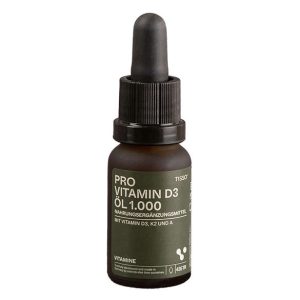
TISSO Naturprodukte TISSO Pro Vitamin D3 Oil 1,000
15 ml · 0.0345 ml per day
Product description
Pro Vitamin D3 Oil 1,000 is not a pure vitamin D oil, but combines 1,000 IU of vitamin D3 per drop with 40 µg vitamin K2 MK-7 and 120 µg vitamin A in an oil matrix. The product character therefore lies in a compact combination of fat-soluble vitamins. From an orthomolecular perspective, not only vitamin D but also vitamin K and vitamin A from other supplements should therefore be included.
Vitamin D3
1,000 IE per dayAssessment by Oliver Fröhner
Micronutrient expert & Food Coach
Product character
Pro Vitamin D3 Oil 1,000 is not a pure vitamin D oil, but combines 1,000 IU of vitamin D3 per drop with 40 µg vitamin K2 MK-7 and 120 µg vitamin A in an oil matrix. The product character therefore lies in a compact combination of fat-soluble vitamins. From an orthomolecular perspective, not only vitamin D but also vitamin K and vitamin A from other supplements should therefore be included. One-drop dosing makes daily intake easy to calculate.
Formula & transparency
- Ingredients list fully checked
- Without microcrystalline cellulose according to the fully reviewed ingredient list
- Without silicon dioxide according to the fully reviewed ingredient list
- Product data reviewed within the freshness period
Points to consider
- A current product- or batch-specific notice is available.
Summary by Oliver Fröhner
Pro Vitamin D3 Oil 1,000 is not a pure vitamin D oil, but combines 1,000 IU of vitamin D3 per drop with 40 µg vitamin K2 MK-7 and 120 µg vitamin A in an oil matrix. The product character therefore lies in a compact combination of fat-soluble vitamins. From an orthomolecular perspective, not only vitamin D but also vitamin K and vitamin A from other supplements should therefore be included.
Manufacturer information and Oliver Fröhner’s editorial assessment are presented separately. Data checked: 15 Sep 2026.
Active ingredients & NRV
Active ingredients
Ingredients & additives
Menachinon (Vitamin K2, all-trans MK-7) (83,4 %); mittelkettiges Triglycerid-Öl (MCT-Öl) auf Kokosbasis; Sanddornfruchtfleischöl; Cholecalciferol (3,1 %); Retinylpalmitat (0,7 %).
Directions & package
Take 1 drop daily.
15 ml · 435 days
Quality, lab & sources
Lab status: No information
Vegetarian; coconut-based MCT oil plus sea buckthorn pulp oil.
Product data checked on 15 Sep 2026.
Notes
If taking blood thinners from the vitamin K antagonist group, consult a qualified professional before use.
Micronutrient knowledge
Micronutrient knowledge
Physiological functions, notes on high or insufficient intake and relevant interactions — presented separately from the specific product assessment.
Vitamin D3
Vitamin D is a fat-soluble vitamin and also a precursor of hormonally active metabolites. For the assessment of supplements, product dose, dosing interval, total intake, 25-OH-vitamin-D status and safety limits are considered separately.
Functions
EU-authorised functions include, among other things: vitamin D contributes to normal absorption and utilisation of calcium and phosphorus, normal blood calcium levels, the maintenance of normal bones and teeth, normal muscle function and normal functioning of the immune system. Vitamin D also has a role in the process of cell division.
Possible signs of insufficient intake
Inadequate vitamin D status cannot be reliably identified from individual nonspecific symptoms. For individual assessment, 25-OH-vitamin-D status together with exposure, diet and supplemental intake is more informative than symptoms alone.
Points to consider at high intake
A markedly excessive vitamin D intake over a prolonged period can lead to hypercalcaemia and hypercalciuria and thereby place a burden on the kidneys and other organ systems. Upper Intake Levels are safety limits for long-term intake and are not optimal target values.
Special considerations
Particular caution is required, among other situations, with diseases or therapies that affect calcium metabolism or kidney function. High doses should not be derived solely from general target values.
Interactions / caution
Vitamin D can interact with certain medicines; relevant examples include drugs that affect calcium or vitamin D metabolism. With prolonged higher-dose use, individual medication should be taken into account.
Vitamin K2
Vitamin K2 belongs to the vitamin K family and includes various menaquinones such as MK-4 and MK-7. MK-7 is commonly used in food supplements. K1 and K2 should not be treated as generally equivalent, even though the authorised vitamin K functions apply to vitamin K as a whole.
Functions
EU-authorised functions: Vitamin K contributes to normal blood clotting and to the maintenance of normal bones.
Possible signs of insufficient intake
Insufficient vitamin K status can impair vitamin-K-dependent blood clotting. An individual assessment should not be based solely on nonspecific symptoms.
Points to consider at high intake
No numerical US UL has been established for vitamin K because of insufficient data and the comparatively low observed toxicity. This does not mean that unlimited dosing is safe, particularly in the presence of relevant medication.
Special considerations
Particular attention is required in people taking vitamin-K-antagonist anticoagulants. In this context, independently changing vitamin K intake is not advisable.
Interactions / caution
Vitamin K can interact clinically significantly with vitamin K antagonists such as warfarin, phenprocoumon and similar anticoagulants. During such therapy, vitamin K intake should only be changed in consultation with the treating medical team.
Vitamin A
Scientific assessment
Studies, meta-analyses and randomized controlled trials on the active ingredient – explained clearly and linked to sources.
The information is provided for factual classification of product and nutrient data. It does not replace medical diagnosis or individual treatment advice.
