


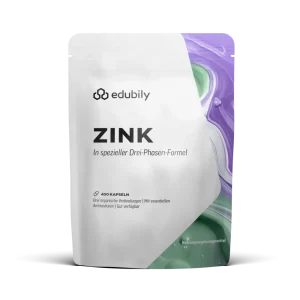
Edubily Zinc Complex Capsules
90 capsules · 1 capsule per day
FOODCOACH
Product description
The Zinc Complex capsules combine 15 mg of zinc from citrate, gluconate and bisglycinate. The product character therefore lies in a multi-form strategy at a moderate-to-higher zinc dose. From an orthomolecular perspective, total daily zinc intake matters more than the number of forms.
Zinc
15 mg per dayAssessment by Oliver Fröhner
Micronutrient expert & Food Coach
Product character
The Zinc Complex capsules combine 15 mg of zinc from citrate, gluconate and bisglycinate. The product character therefore lies in a multi-form strategy at a moderate-to-higher zinc dose. From an orthomolecular perspective, total daily zinc intake matters more than the number of forms. With long-term use, additional zinc sources should be avoided and the balance with copper should be kept in mind.
Formula & transparency
- Ingredients list fully checked
- Without microcrystalline cellulose according to the fully reviewed ingredient list
- Without silicon dioxide according to the fully reviewed ingredient list
- Lab report verified
- Product data reviewed within the freshness period
Points to consider
- A current product- or batch-specific notice is available.
Data basis
- HPMC/hydroxypropyl methylcellulose is declared.
Summary by Oliver Fröhner
The Zinc Complex capsules combine 15 mg of zinc from citrate, gluconate and bisglycinate. The product character therefore lies in a multi-form strategy at a moderate-to-higher zinc dose. From an orthomolecular perspective, total daily zinc intake matters more than the number of forms.
Manufacturer information and Oliver Fröhner’s editorial assessment are presented separately. Data checked: 15 Sep 2026.
Active ingredients & NRV
Active ingredients
Ingredients & additives
Hydroxypropylmethylcellulose (Kapselhülle), L-Cysteinhydrochlorid, L-Histidinhydrochlorid, Leucin, L-Lysinhydrochlorid, L-Valin, Zinkbisglycinat, Zinkgluconat, L-Isoleucin, L-Threonin, L-Phenylalanin, Zinkcitrat, L-Tryptophan, L-Methionin.
Directions & package
Swallow 1 capsule daily with sufficient liquid.
90 capsules · 90 days
Quality, lab & sources
Lab status: Lab report verified
15 mg zinc from three declared zinc forms plus amino-acid matrix; vegan; official test report linked.
Product data checked on 15 Sep 2026.
Notes
According to the manufacturer, no other zinc-containing supplements should be taken alongside this product. Taking it on an empty stomach may cause nausea. Edubily does not state a general contraindication for pregnancy or breastfeeding, but recommends medical clarification if in doubt.
Nutrient knowledge & reference values
Nutrient knowledge & reference values
General nutrient information for interpreting the product dosage. Signs of insufficient or excessive intake are non-specific and do not replace a diagnosis.
Zinc
Zinc is an essential trace element. The assessment considers the EU NRV, total intake, product dose and interactions—particularly with copper and medicines—separately.
Functions
EU-authorised health-claim functions include, among other things: zinc contributes to the normal function of the immune system, normal cognitive function, normal DNA synthesis, normal fertility and reproduction, and normal acid-base and carbohydrate metabolism. Zinc contributes to the maintenance of normal bones, hair, nails, skin and vision, protects cells from oxidative stress and has a role in the process of cell division.
Possible signs of insufficient intake
Zinc deficiency can be associated, among other things, with loss of appetite, impaired taste and smell, delayed wound healing, hair loss, growth impairment and increased susceptibility to infections. These symptoms are nonspecific and do not allow self-diagnosis.
Points to consider at high intake
Excessive zinc intake can cause nausea, vomiting, headaches and gastrointestinal symptoms. Chronically high amounts can inhibit copper absorption and thereby promote copper deficiency. The European EFSA/SCF UL for adults is 25 mg of zinc per day from total intake.
Special considerations
An increased risk of inadequate zinc intake exists, among other situations, with certain gastrointestinal diseases or after bariatric surgery, with strongly plant-based diets with low zinc bioavailability, during pregnancy and breastfeeding, and with chronically high alcohol consumption.
Interactions / caution
Zinc can reduce the absorption of quinolone and tetracycline antibiotics as well as penicillamine; dosing intervals should be observed. Thiazide diuretics can increase zinc excretion. Long-term high zinc intake can reduce copper absorption.
FOODCOACH
The information is provided for factual classification of product and nutrient data. It does not replace medical diagnosis or individual treatment advice.
