


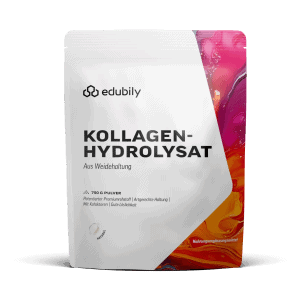
Edubily Collagen Hydrolysate Powder – Natural
750 g · 15 g per day
FOODCOACH
Product description
The collagen hydrolysate is primarily a protein-based structural product: 15 g of powder provides 14.75 g of collagen hydrolysate and is complemented by vitamin C, zinc, copper, manganese and silicon. The product character therefore clearly lies in a high collagen amount plus selected cofactors. From a holistic perspective, collagen should still be considered in the context of total protein intake, training load, physical activity and overall diet quality; the product does not replace a varied protein supply.
Assessment by Oliver Fröhner
Micronutrient expert & Food Coach
Product character
The collagen hydrolysate is primarily a protein-based structural product: 15 g of powder provides 14.75 g of collagen hydrolysate and is complemented by vitamin C, zinc, copper, manganese and silicon. The product character therefore clearly lies in a high collagen amount plus selected cofactors. From a holistic perspective, collagen should still be considered in the context of total protein intake, training load, physical activity and overall diet quality; the product does not replace a varied protein supply.
Formula & transparency
- Ingredients list fully checked
- Without microcrystalline cellulose according to the fully reviewed ingredient list
- Without silicon dioxide according to the fully reviewed ingredient list
- Lab report verified
- Product data reviewed within the freshness period
Points to consider
- A current product- or batch-specific notice is available.
Summary by Oliver Fröhner
The collagen hydrolysate is primarily a protein-based structural product: 15 g of powder provides 14.75 g of collagen hydrolysate and is complemented by vitamin C, zinc, copper, manganese and silicon. The product character therefore clearly lies in a high collagen amount plus selected cofactors. From a holistic perspective, collagen should still be considered in the context of total protein intake, training load, physical activity and overall diet quality; the product does not replace a varied protein supply.
Manufacturer information and Oliver Fröhner’s editorial assessment are presented separately. Data checked: 19 Sep 2026.
Active ingredients & NRV
Active ingredients
Analysis & nutrient values
Nährwerte
Essentielle Aminosäuren
Nicht-essentielle Aminosäuren
Weitere Aminosäuren
Other
Ingredients & additives
98,3 % Kollagenhydrolysat (Weiderind), Acerola-Extrakt, Zinkbisglycinat, Kieselsäure, Mangangluconat, Kupfergluconat.
Directions & package
Take 15 g powder daily. A 750 g pack contains approx. 50 servings.
750 g · 50 days
Quality, lab & sources
Lab status: Lab report verified
Collagen hydrolysate from pasture-raised cattle; Kölner Liste® (Cologne List); product data sheet and independent test report publicly linked.
Product data checked on 19 Sep 2026.
Notes
Animal-derived product from bovine collagen. Do not exceed the recommended daily amount; keep out of reach of young children.
Nutrient knowledge & reference values
Nutrient knowledge & reference values
General nutrient information for interpreting the product dosage. Signs of insufficient or excessive intake are non-specific and do not replace a diagnosis.
Vitamin C
Vitamin C (ascorbic acid) is an essential water-soluble vitamin. presents physiological functions, the EU NRV, safety assessment and product-specific dosage separately.
Functions
EU-authorised health-claim functions include, among other things: vitamin C contributes to normal collagen formation for the normal function of blood vessels, bones, cartilage, gums, skin and teeth. It contributes to normal energy-yielding metabolism, normal functioning of the nervous system and immune system, and the protection of cells from oxidative stress. Vitamin C also contributes to the reduction of tiredness and fatigue and increases iron absorption.
Possible signs of insufficient intake
Severe vitamin C deficiency can lead to scurvy. Reported signs include fatigue, inflammation of the gums, pinpoint bleeding, increased capillary fragility and delayed wound healing. Such symptoms are not suitable for self-diagnosis.
Points to consider at high intake
EFSA was unable to derive a UL for vitamin C because of insufficient data. High additional intake can mainly cause gastrointestinal symptoms such as diarrhoea, nausea, bloating or abdominal cramps. With very high amounts, individual risk factors should be taken into account.
Special considerations
An increased risk of inadequate intake exists, among other situations, with a very one-sided diet, malabsorption and in smokers or people with substantial passive-smoke exposure. In haemochromatosis, particular caution is advisable with high-dose vitamin C because it increases non-haem iron absorption.
Interactions / caution
Vitamin C can increase non-haem iron absorption. High-dose supplementation in haemochromatosis should only be used after professional consultation. During chemotherapy or radiotherapy, high-dose antioxidant supplementation should be coordinated with the treating team.
Zinc
Zinc is an essential trace element. The assessment considers the EU NRV, total intake, product dose and interactions—particularly with copper and medicines—separately.
Functions
EU-authorised health-claim functions include, among other things: zinc contributes to the normal function of the immune system, normal cognitive function, normal DNA synthesis, normal fertility and reproduction, and normal acid-base and carbohydrate metabolism. Zinc contributes to the maintenance of normal bones, hair, nails, skin and vision, protects cells from oxidative stress and has a role in the process of cell division.
Possible signs of insufficient intake
Zinc deficiency can be associated, among other things, with loss of appetite, impaired taste and smell, delayed wound healing, hair loss, growth impairment and increased susceptibility to infections. These symptoms are nonspecific and do not allow self-diagnosis.
Points to consider at high intake
Excessive zinc intake can cause nausea, vomiting, headaches and gastrointestinal symptoms. Chronically high amounts can inhibit copper absorption and thereby promote copper deficiency. The European EFSA/SCF UL for adults is 25 mg of zinc per day from total intake.
Special considerations
An increased risk of inadequate zinc intake exists, among other situations, with certain gastrointestinal diseases or after bariatric surgery, with strongly plant-based diets with low zinc bioavailability, during pregnancy and breastfeeding, and with chronically high alcohol consumption.
Interactions / caution
Zinc can reduce the absorption of quinolone and tetracycline antibiotics as well as penicillamine; dosing intervals should be observed. Thiazide diuretics can increase zinc excretion. Long-term high zinc intake can reduce copper absorption.
Copper
Copper is an essential trace element and a component of numerous enzyme systems. Product dose, total intake and the relationship with other trace elements—especially zinc—should be assessed separately.
Functions
EU-authorised health-claim functions include: copper contributes to the maintenance of normal connective tissues, normal energy-yielding metabolism, normal functioning of the nervous system and immune system, and the protection of cells from oxidative stress. It also contributes to normal iron transport in the body and to normal hair and skin pigmentation.
Possible signs of insufficient intake
Copper deficiency is rare. Reported signs include pronounced fatigue, abnormalities of connective tissue and bone, neurological symptoms, impaired coordination and increased susceptibility to infections. Diagnosis of deficiency requires professional assessment.
Points to consider at high intake
Chronically excessive copper intake can cause nausea, abdominal pain, vomiting, diarrhoea and liver damage, among other effects. The European EFSA/SCF UL for adults is 5 mg of copper per day from total intake. Special medical requirements apply in Wilson disease.
Special considerations
An increased risk of inadequate copper status may occur, among other situations, in coeliac disease, rare disorders of copper metabolism such as Menkes disease, and with long-term very high zinc intake. For people with Wilson disease, additional copper intake without medical supervision is not appropriate.
Interactions / caution
High zinc intake can reduce intestinal copper absorption and, with prolonged use, promote copper deficiency. No widespread clinically relevant drug interactions are established for copper; disease-specific situations such as Wilson disease require medical management.
Manganese
Manganese is an essential trace element and a cofactor for various enzymes. For safety assessment, it is important that EFSA could not derive a UL and instead established a Safe Level for total intake.
Functions
EU-authorised health-claim functions: manganese contributes to normal energy-yielding metabolism, the maintenance of normal bones, normal formation of connective tissue and the protection of cells from oxidative stress.
Possible signs of insufficient intake
Manganese deficiency is very rare in humans; typical deficiency symptoms are not clearly established. Limited data have described, among other things, changes in bone metabolism, growth, skin and carbohydrate metabolism. These findings are not suitable for self-diagnosis.
Points to consider at high intake
Excessive manganese exposure can cause neurological damage. In 2023, EFSA was unable to establish a UL and instead uses a Safe Level of 8 mg/day for adults from total intake from all dietary sources. Exceeding the Safe Level does not automatically mean a health risk and must not be interpreted like a UL.
Special considerations
No clearly defined general risk groups for inadequate intake are known. Iron deficiency can increase manganese absorption. In chronic liver disease, biliary excretion may be reduced, which can increase sensitivity to excessive manganese exposure. Occupational inhalation exposure must be distinguished from oral dietary intake.
Interactions / caution
No clinically relevant drug interactions are generally established for manganese. In liver disease and with unusually high total intake, particular caution is warranted because of manganese homeostasis.
Silicon
Silicon occurs naturally in foods and can be present in food supplements from different sources. The essentiality of silicon for humans has not been established by EFSA; no EU NRV has been set.
Functions
No essential physiological function of silicon has been clearly established in humans, and there is no general authorised EU health claim for a normal body function. therefore does not derive any broader functional claims.
Possible signs of insufficient intake
A clinically defined silicon deficiency syndrome has not been established in humans. Deficiency symptoms are therefore not stated.
Points to consider at high intake
EFSA was unable to establish a UL for silicon because suitable dose-response data are lacking. In an EFSA assessment, a usual dietary intake of about 20–50 mg of silicon per day was described as unlikely to cause adverse effects. Safety assessments are source- and form-specific and must not be transferred indiscriminately between silicic acid, orthosilicic acid, silicon dioxide and other silicon compounds.
Special considerations
No established risk groups for silicon deficiency have been defined. For products, the specific silicon source must be stated accurately; in particular, silicic acid must not automatically be classified as the additive silicon dioxide.
Interactions / caution
No generally recognised clinically relevant drug interactions are established for usual oral silicon intake. Safety statements should refer to the specifically declared silicon source and dose.
Scientific assessment
Studies, meta-analyses and randomized controlled trials on the active ingredient – explained clearly and linked to sources.
FOODCOACH
The information is provided for factual classification of product and nutrient data. It does not replace medical diagnosis or individual treatment advice.
