


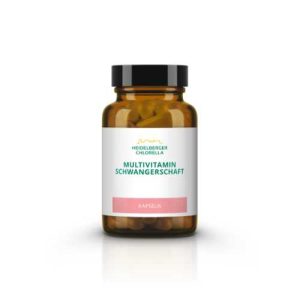
Heidelberger Chlorella Prenatal Multivitamin Capsules
60 capsules · 1 capsule per day
Product description
This pregnancy multivitamin is specifically designed for prenatal micronutrient coverage. Key features include 800 µg folate as 5-MTHF, 14 mg iron, 150 µg iodine, 10 mg zinc, 25 µg vitamin D3 and bioactive forms of vitamins B2, B6 and B12. The product character therefore lies in a comprehensive pregnancy-focused formula rather than in a standard everyday multivitamin.
Assessment by Oliver Fröhner
Micronutrient expert & Food Coach
Product character
This pregnancy multivitamin is specifically designed for prenatal micronutrient coverage. Key features include 800 µg folate as 5-MTHF, 14 mg iron, 150 µg iodine, 10 mg zinc, 25 µg vitamin D3 and bioactive forms of vitamins B2, B6 and B12. The product character therefore lies in a comprehensive pregnancy-focused formula rather than in a standard everyday multivitamin. From an orthomolecular perspective, iron, iodine, vitamin D and folate in particular should be aligned with diet, laboratory status and any additional prenatal supplements to avoid unnecessary duplication.
Formula & transparency
- Ingredients list fully checked
- Product data reviewed within the freshness period
Points to consider
- A current product- or batch-specific notice is available.
- Microcrystalline cellulose is declared.
- Silicon dioxide is declared.
Data basis
- Quality/laboratory status is based on manufacturer information
- HPMC/hydroxypropyl methylcellulose is declared.
Summary by Oliver Fröhner
This pregnancy multivitamin is specifically designed for prenatal micronutrient coverage. Key features include 800 µg folate as 5-MTHF, 14 mg iron, 150 µg iodine, 10 mg zinc, 25 µg vitamin D3 and bioactive forms of vitamins B2, B6 and B12. The product character therefore lies in a comprehensive pregnancy-focused formula rather than in a standard everyday multivitamin.
Manufacturer information and Oliver Fröhner’s editorial assessment are presented separately. Data checked: 21 Sep 2026.
Active ingredients & NRV
Active ingredients
Ingredients & additives
Calciumascorbat; Eisen(II)-Gluconat; Hydroxypropylmethylcellulose (Kapselhülle); Zinkgluconat; Nicotinamid; Vitamin E (gemischte Tocotrienole/Tocopherol-Konzentrat; modifizierte Stärke; Dextrin); Vitamin D3 (modifizierte Stärke; Maltodextrin; pflanzliches Öl (Mais); Saccharose; Antioxidationsmittel: Alpha-Tocopherol, Natriumascorbat; Trennmittel: Siliciumdioxid; Cholecalciferol); D-Calciumpantothenat; Vitamin K2 (Trägerstoffe: mikrokristalline Cellulose; mittelkettige Triglyceride; Vitamin K2 als Menaquinon-7); Pyridoxal-5-Phosphat; Natrium-Riboflavin-5-Phosphat; Thiaminhydrochlorid; Vitamin A (Saccharose; Maisstärke; Verdickungsmittel: Gummi arabicum; Retinylacetat; Antioxidationsmittel: DL-alpha-Tocopherol; Trennmittel: Tricalciumphosphat); (6S)-5-Methyltetrahydrofolsäure-Glucosaminsalz; D-Biotin; Chrom(III)-Chlorid; Kaliumjodid; Natriumselenit; Methylcobalamin.
Directions & package
Take 1 capsule daily. If taking anticoagulants, consult your doctor.
60 capsules · 60 days
Quality, lab & sources
Lab status: Manufacturer information
Active folate form 5-MTHF, bioactive B2/B6/B12 forms, vitamin K2 MK-7; 800 µg folate, 14 mg iron, 150 µg iodine, 10 mg zinc and 25 µg vitamin D3 per daily serving. Contains HPMC, microcrystalline cellulose, silicon dioxide and gum arabic as declared excipients/carriers.
Product data checked on 21 Sep 2026.
Notes
Manufacturer note: if taking anticoagulants, consult your doctor.
Nutrient knowledge & reference values
Nutrient knowledge & reference values
General nutrient information for interpreting the product dosage. Signs of insufficient or excessive intake are non-specific and do not replace a diagnosis.
Vitamin C
Vitamin C (ascorbic acid) is an essential water-soluble vitamin. presents physiological functions, the EU NRV, safety assessment and product-specific dosage separately.
Functions
EU-authorised health-claim functions include, among other things: vitamin C contributes to normal collagen formation for the normal function of blood vessels, bones, cartilage, gums, skin and teeth. It contributes to normal energy-yielding metabolism, normal functioning of the nervous system and immune system, and the protection of cells from oxidative stress. Vitamin C also contributes to the reduction of tiredness and fatigue and increases iron absorption.
Possible signs of insufficient intake
Severe vitamin C deficiency can lead to scurvy. Reported signs include fatigue, inflammation of the gums, pinpoint bleeding, increased capillary fragility and delayed wound healing. Such symptoms are not suitable for self-diagnosis.
Points to consider at high intake
EFSA was unable to derive a UL for vitamin C because of insufficient data. High additional intake can mainly cause gastrointestinal symptoms such as diarrhoea, nausea, bloating or abdominal cramps. With very high amounts, individual risk factors should be taken into account.
Special considerations
An increased risk of inadequate intake exists, among other situations, with a very one-sided diet, malabsorption and in smokers or people with substantial passive-smoke exposure. In haemochromatosis, particular caution is advisable with high-dose vitamin C because it increases non-haem iron absorption.
Interactions / caution
Vitamin C can increase non-haem iron absorption. High-dose supplementation in haemochromatosis should only be used after professional consultation. During chemotherapy or radiotherapy, high-dose antioxidant supplementation should be coordinated with the treating team.
Vitamin B6
Vitamin A
Vitamin D3
Vitamin D is a fat-soluble vitamin and also a precursor of hormonally active metabolites. For the assessment of supplements, product dose, dosing interval, total intake, 25-OH-vitamin-D status and safety limits are considered separately.
Functions
EU-authorised functions include, among other things: vitamin D contributes to normal absorption and utilisation of calcium and phosphorus, normal blood calcium levels, the maintenance of normal bones and teeth, normal muscle function and normal functioning of the immune system. Vitamin D also has a role in the process of cell division.
Possible signs of insufficient intake
Inadequate vitamin D status cannot be reliably identified from individual nonspecific symptoms. For individual assessment, 25-OH-vitamin-D status together with exposure, diet and supplemental intake is more informative than symptoms alone.
Points to consider at high intake
A markedly excessive vitamin D intake over a prolonged period can lead to hypercalcaemia and hypercalciuria and thereby place a burden on the kidneys and other organ systems. Upper Intake Levels are safety limits for long-term intake and are not optimal target values.
Special considerations
Particular caution is required, among other situations, with diseases or therapies that affect calcium metabolism or kidney function. High doses should not be derived solely from general target values.
Interactions / caution
Vitamin D can interact with certain medicines; relevant examples include drugs that affect calcium or vitamin D metabolism. With prolonged higher-dose use, individual medication should be taken into account.
Vitamin K2
Vitamin K2 belongs to the vitamin K family and includes various menaquinones such as MK-4 and MK-7. MK-7 is commonly used in food supplements. K1 and K2 should not be treated as generally equivalent, even though the authorised vitamin K functions apply to vitamin K as a whole.
Functions
EU-authorised functions: Vitamin K contributes to normal blood clotting and to the maintenance of normal bones.
Possible signs of insufficient intake
Insufficient vitamin K status can impair vitamin-K-dependent blood clotting. An individual assessment should not be based solely on nonspecific symptoms.
Points to consider at high intake
No numerical US UL has been established for vitamin K because of insufficient data and the comparatively low observed toxicity. This does not mean that unlimited dosing is safe, particularly in the presence of relevant medication.
Special considerations
Particular attention is required in people taking vitamin-K-antagonist anticoagulants. In this context, independently changing vitamin K intake is not advisable.
Interactions / caution
Vitamin K can interact clinically significantly with vitamin K antagonists such as warfarin, phenprocoumon and similar anticoagulants. During such therapy, vitamin K intake should only be changed in consultation with the treating medical team.
Zinc
Zinc is an essential trace element. The assessment considers the EU NRV, total intake, product dose and interactions—particularly with copper and medicines—separately.
Functions
EU-authorised health-claim functions include, among other things: zinc contributes to the normal function of the immune system, normal cognitive function, normal DNA synthesis, normal fertility and reproduction, and normal acid-base and carbohydrate metabolism. Zinc contributes to the maintenance of normal bones, hair, nails, skin and vision, protects cells from oxidative stress and has a role in the process of cell division.
Possible signs of insufficient intake
Zinc deficiency can be associated, among other things, with loss of appetite, impaired taste and smell, delayed wound healing, hair loss, growth impairment and increased susceptibility to infections. These symptoms are nonspecific and do not allow self-diagnosis.
Points to consider at high intake
Excessive zinc intake can cause nausea, vomiting, headaches and gastrointestinal symptoms. Chronically high amounts can inhibit copper absorption and thereby promote copper deficiency. The European EFSA/SCF UL for adults is 25 mg of zinc per day from total intake.
Special considerations
An increased risk of inadequate zinc intake exists, among other situations, with certain gastrointestinal diseases or after bariatric surgery, with strongly plant-based diets with low zinc bioavailability, during pregnancy and breastfeeding, and with chronically high alcohol consumption.
Interactions / caution
Zinc can reduce the absorption of quinolone and tetracycline antibiotics as well as penicillamine; dosing intervals should be observed. Thiazide diuretics can increase zinc excretion. Long-term high zinc intake can reduce copper absorption.
Selenium
Selenium is an essential trace element. Product dosage, selenium form, reference values and total intake are considered separately in the assessment.
Functions
Selenium is a component of various selenoproteins and plays a role, among other things, in antioxidant defence systems, the regulation of thyroid-hormone metabolism and normal immune-system function.
Possible signs of insufficient intake
Insufficient selenium intake can impair various selenium-dependent enzyme systems. Symptoms are nonspecific; for an individual assessment, diet, supplemental intake and, where appropriate, laboratory parameters should be considered together.
Points to consider at high intake
Chronically high selenium intake can lead to selenosis. Reported signs include changes in hair and nails, a metallic taste, garlic-like breath, as well as gastrointestinal and neurological symptoms.
Special considerations
Baseline selenium status is particularly relevant when interpreting selenium studies. High additional intake is not automatically beneficial when selenium status is already adequate.
Interactions / caution
With high-dose long-term use, total intake from food and supplements should be taken into account. Individual medical conditions and drug therapies may require a separate assessment.
Scientific assessment
Studies, meta-analyses and randomized controlled trials on the active ingredient – explained clearly and linked to sources.
The information is provided for factual classification of product and nutrient data. It does not replace medical diagnosis or individual treatment advice.
